Sunday, August 12, 2012

10 Custom Apple iPad Mods [VIDEOS]


Apple has never failed to amaze us but so have its users. There seems to be something about Apple’s iPad that brings out a user’s inventive side. In its short life, we have already seen some amazing uses. Recently we saw some odd iPad uses. Here we bring you ten more cool iPad creations that take the tablet device and mod it into something bigger, better or just more fun. Enjoy!


No 10. My Kitchen iPad

While hacking a great big hole in your expensive kitchen cabinetry is not something we’d normally recommend, in this instance it’s more than justified. This cupboard of awesome has been transformed into a media center while offering a really handy way to access cooking apps.


No 9. Apple iPad Macintosh


We just love the mix of retro and modern tech in this genius idea that takes a Macintosh Classic and brings it right up to date with the addition of a shiny new iPad.


No 8. iPad Dock From Credit Card

Bored in office the guy devised an out-of-wallet Dock. The dock used three wood soap dishes and a folded up credit card


No 7. iBook – iPad Modification

More classic Mac action here as an old clamshell iBook (kids – this is what we had before MacBooks were invented) gets modified to fit the iPad into its display. We have to say it works really well, although we were always more partial to the “tangerine” model.


No 6. iPad 3G GPS AT&T 3G Motorcycle Navigation System
iPad 3G GPS AT&T 3G Motorcycle Navigation System. Guy set up iPad 3G onto my KLR 650 Special Forces Modified w $10K of Mods Motorcycle iPad 3G fixed to the map case. iPad MAPS GPS works perfect with compass satellite and terrain modes, knows exactly the direction and follows you on the Map and you can multi-task too with the iPod in the iPad and have music going with the GPS Navigation it’s great.


No 5. Modifying the iPad Case to fit into the iPad Dock
John Hubickey from HubuMedia.com shows you how to Modify your iPad case to fit in to the iPad Dock


No 4. Installing iPad in Car DashBoard

The day of the iPad launch, Doug Bernards installs an iPad in his car alongside an Audison Bit One processor. Planned install will include a McIntosh 6 channel amplifier MCC406M, and a special iPod dock which allows the digital signal to be pulled from the iPad and distributed to the BitOne via optical output.


No 3. iPad Walking Robot

Utterly pointless but incredibly sweet, the iPad walking robot was the inevitable follow-up to the iPhone walking robot — and don’t they just make the cutest pair!


No 2. Hammerhead Axepad iPad Guitar

A combo of hardware add-ons and apps turns the humble iPad into the — drumroll please — Hammerhead Axepad! Created by VJFranzK, who appears to be quite a character, this is the “glow edition” – just in case you were worried you might not make enough of an impression with the device strapped to your chest.


No 1. Fishman’s iPad Install

iPad car installs are ten a penny, but while most are decidedly dull and involve Velcro or plastic mounts, this effort brings the wow factor with some smooth motorized action and shiny chrome.

The Museum Of Optical Illusions


The Trick Art Museum in Seogwipo City is one of the most amazing museums you could ever see. Famous for its optical illusions, its galleries are loaded with paintings that trick and deceive the human eye. Exhibitions on the floor as well as the wall give depth to the illusions making it easier to interact with them, or so it seems when you capture the scene in pictures.
Be it the multi-headed hydra or a cliff, each painting has something unique to offer in terms of interactive illusions. Each art looks different from every angle. The effect is magnified when you look at it through a camera. Enjoy the following pictures.


10 Most Outrageous Military Experiments


We suspect that every military has a secret room full of stoned dudes who stare at the ceiling and just dream up shit to build. In support of our “secret room full of stoned dudes” theory, we offer the following actual military projects that stretch the limits of the non-stoned imagination

10-Seeing Infrared


The U.S. Navy wanted to boost sailors’ night vision so they could spot infrared signal lights during World War II. However, infrared wavelengths are normally beyond the sensitivity of human eyes. Scientists knew vitamin A contained part of a specialized light-sensitive molecule in the eye’s receptors, and wondered if an alternate form of vitamin A could promote different light sensitivity in the eye. They fed volunteers supplements made from the livers of walleyed pikes, and the volunteers’ vision began changing over several months to extend into the infrared region. Such early success went down the drain after other researchers developed an electronic snooperscope to see infrared, and the human study was abandoned. Other nations also played with vitamin A during World War II – Japan fed its pilots a preparation that boosted vitamin A absorption, and saw their night vision improve by 100 percent in some cases.\


Saturday, August 11, 2012

A Camera That Is Controlled With Your Eyes


A new idea enters the battle of camera and photography. Of all the futuristic cameras and their concepts, this idea is the coolest one. This new camera works on the new technology of eye-tracking and biometric detection, helping the device to take photos smoothly on the blink of your eye. Function of this camera is way too awesome; you can zoom in by squinting your eyes slightly and zoom out by opening your eyes wider. When you are ready to take the photo, you just need to blink your eyes twice.
Unlike other cameras till now, this camera will recognize user’s identity and their lens power. Moreover, while using this camera, you don’t need to actually see through the lens, instead, you’ll have the ease of looking at the digital display mounted on one of its end. And that display will automatically create a backing where the shutter and sensors will be located.
The device is still a prototype and is rumored to be Wifi-enabled as well.


Friday, August 10, 2012

The New iOS To Come up With Its Own Maps

Previously we heard that Apple has been working to build its own maps, the procedure was reported to be in development and in experimental stage but now it gets confirmed that in iOS 6 Apple would be introducing there own Maps instead of Google Maps. So for all Apple fans out there, its a big news! The new maps made by Apple would also be having 3D views along with different other options, and according to some confirmed sources the the maps would “blow your head”. So lets wait and watch what Apple brings out! After all it would be the first competitor of Google, so if it performs upto expectations, Google would definitely have a tough competition. We will look forward for these maps in the coming iPhone 5.


Three or More Days Spent in Total Darkness Can Lead to Permanent Blindness?


Eyes are one of the greatest blessings. It is probably one of the most complicated organ in our body too. To live a life without eyes is a scary thought. Most of our everyday tasks are optimized by visual feedback our brain receives. We are dependent on our eyes – if we can’t see, we can’t understand and so can’t we work. Imagining a life without eyes is impossible but ever wondered what about those who are born blind? 39 million people are blind worldwide. Every year thousands of children are born blind due to genetic problems. Others are blind due to diseases such as retinitis pigmentosa. Many new eye treatments are on way, but some diseases which cause blindness are uncurable. Many researchers are also attempting to make artificial eyes.


It is said that if an individual is left in dark for three or more days, then the individual is at risk of losing his eyesight permanently. This study was done at an Australian health Institute recently. However, there is no practical research supporting this fact. Hence, for now, this is only a myth presented by a study. Other myths also exist, such as for example, sitting too close to the TV for long enough makes you blind.However, Most of these are not based on facts.

FPS Quad-copter Reality Or Fake, You Decide!


A famous Youtube Channel FPS has made great fame undoubtedly as its always fun to watch real guns, real ammos and real firing. So does the Russian chap does, he has been famous for trying all tiny to deadly weapons and he posts a video at his channel of the shooting one after the other. Mostly the Russian firearms are tested and he blows some dummies and cars with those bullets and explosions.
His latest coverage was a quadcopter! Now this is amazing if it is real! As the quadcopter which according to him has no such defined specs but has a pretty name “Charlene” In the video he flies his quadcopter with a tablet and shoots through it while using the same tablet. The quadcopter is equipped with a camera and some heavy duty guns to blow some dummies. A very strange act yet made me think twice that if its a fake video as at the end of his video he blows his quadcopter in a car and without disclosing any of detail, and there he ends up the session. Well if still in case this invention is real we are not going to see this military equipment sooner.
Watch the video and tell us what do you think about it.


Single Sewing Thread Wrapped Around Nails To Make Unbelievable Portraits


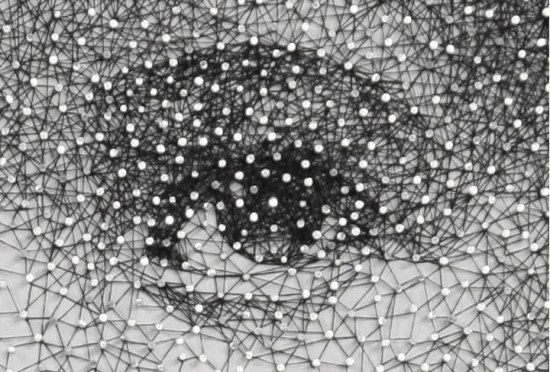
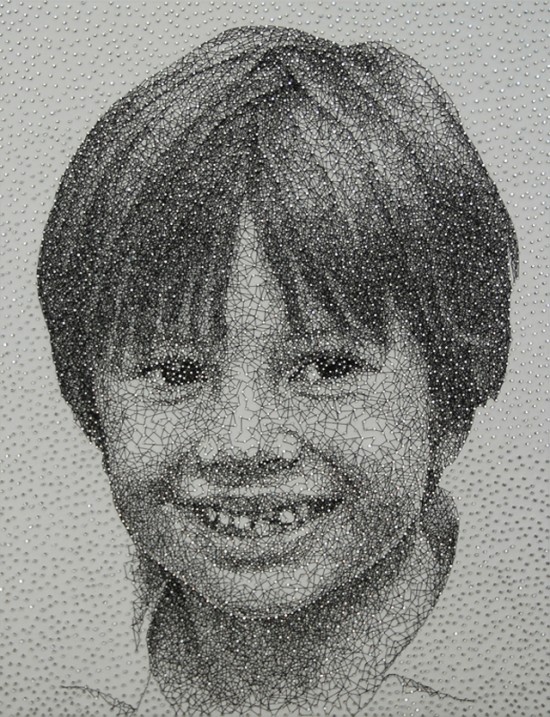
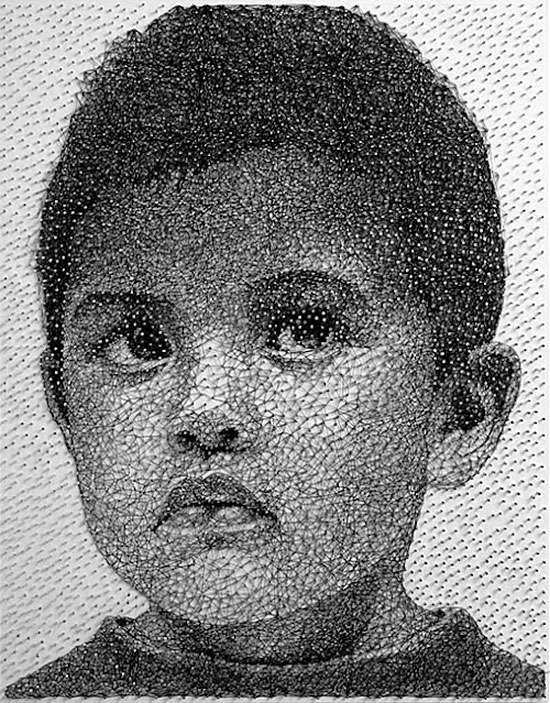
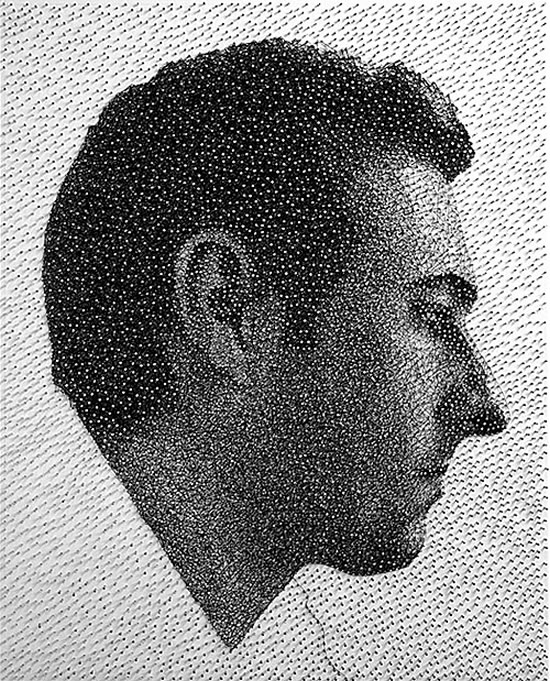
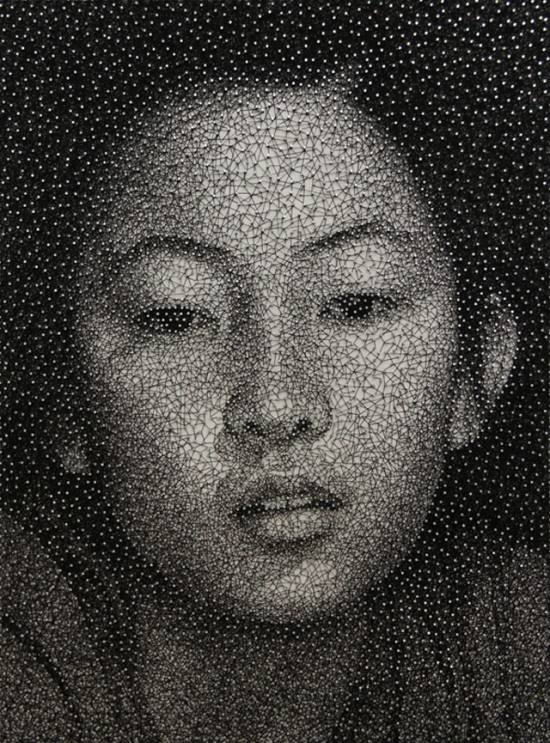
Kumi Yamashita from Japan makes some truly jaw dropping art. The portraits are made while wrapping an Unbroken thread over nails. The mind boggling art stuns you for a while at first. We have seen nail-art before as well, but this Yamashita art is some legendary work which is bound to live on for decades.
She bolted nails over a white background and then started weaving the thread all over until she got what she desired. You can see clearly in the pictures below that whereever she wanted to give some depth to the picture, she increased the thread turns. Once the portrait is complete, you can see a fine piece of art and appreciate the effort made during its formation. The amount of patience and struggle speaks for itself in the portraits. I have never seen such remarkable art elsewhere, hats off to Yamashita.


Stunning Paper Art!


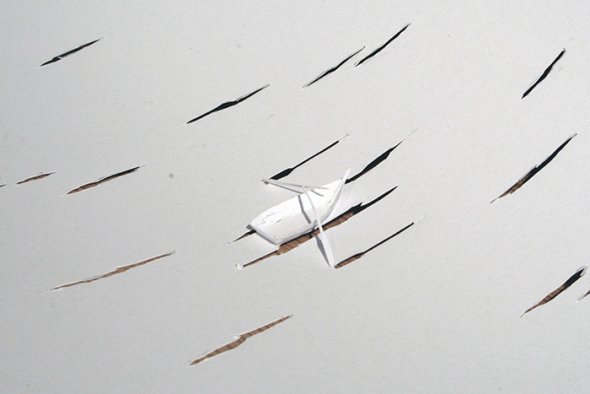
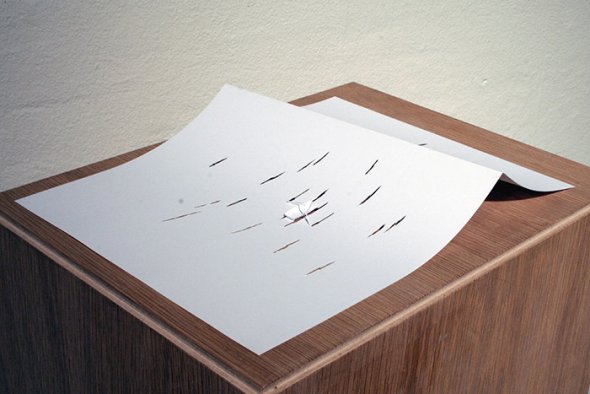
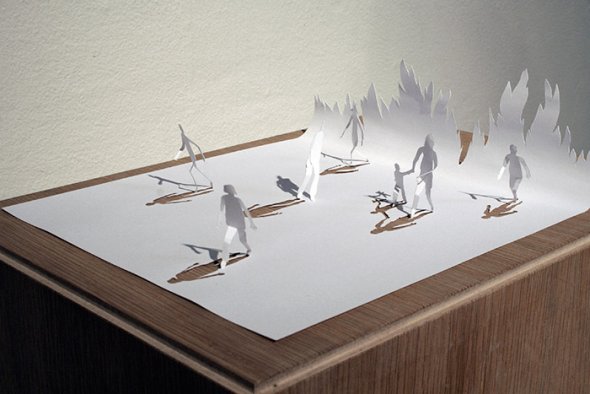
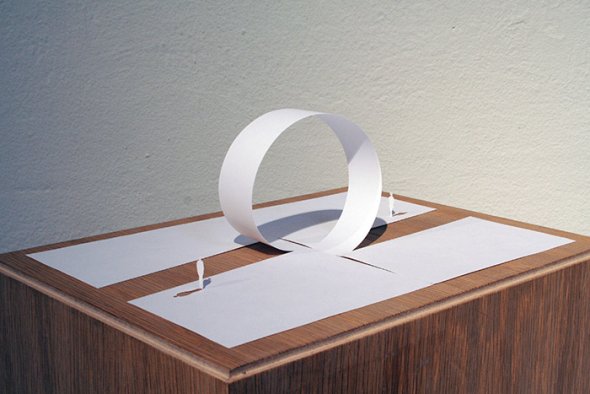
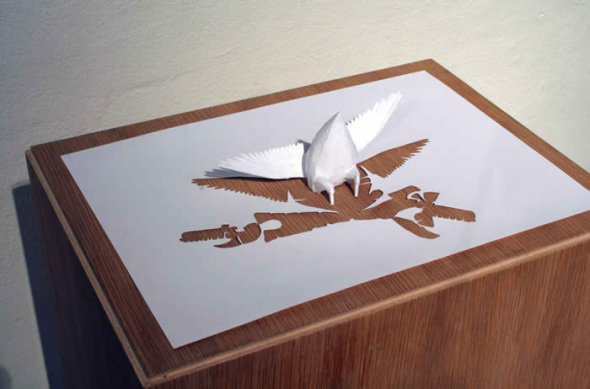
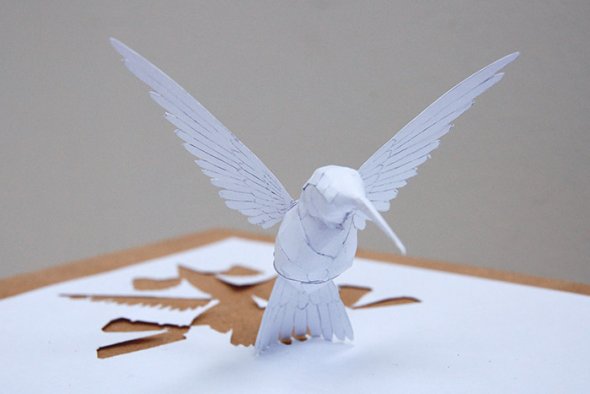
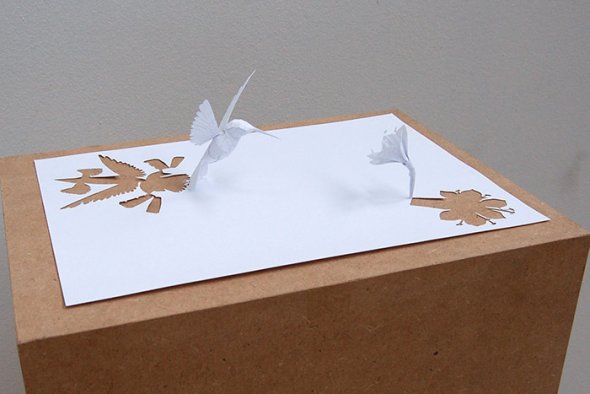
Peter Callesen is not an ordinary artist. His artistic qualities are truly remarkable as h uses his extraordinary imagination skills to cut a figure from just one piece of paper. And that’s not the end of the story, he also uses those cut pieces to make stunning 3D figures. Furthermore, to make you drop your jaw, it’s all made from a single piece of paper in one go; without any mistake. The cut work is simply amazing! Both figure and the cut work combine to make a story which the viewers can’t just let go without appreciating the thoughts and efforts of the artist.
I am sure you will be amazed too after watching his work. Words cannot explain what he creates. Sit back and enjoy his artwork below.


Thursday, August 9, 2012

Crazy Skater Turn His House Into A Skate Park


f you are crazy about skating then this is the news for you. Philipp Schuster turned his house into a skate park without completely disturbing the house looks. He used concrete to make some ramps and jumps so that he could skate out any where in the house. He used the theme of his house intelligently and merged his skate concepts in it.
Overall its a great idea to have a room or a house like this for practising your skate skills all the time. Now if you are thinking of doing something like this in your own backyard, its time to start doing things to make your mom happy.
Watch the video below to see how the ramps and jumps actually look like in a house.

What’s New In The Mobile World?

The current generation of mobile phones is coming to an end, and we are seeing the beginnings of an entirely new generation. Apple’s iPhone 4s has been a huge success, but according to many sources the design of the soon to be released iPhone 5 is a massive shift in the way we think about mobile devices as a whole. At the launch of the Galaxy S III which you can find at http://www.phones4u.co.uk/, we were told that this was the way all devices would work in the future; more responsive to actual human interaction, and more integration with the tasks that we as consumers perform on a day to day basis.

Because of the constantly moving nature of technology, we are seeing products that are only going to be state of the art for, at the most, six months. Innovations are never far away, and the pace of advancement means that we are constantly being shown the newest thing that will change the way we live. Screen quality has seen a massive boost in the last few years, so that will more than likely not change very much; similarly we will probably not see a massive shift in the size of devices available, but the capacity, capability and performance will continue to grow and the rate will increase as we move into the future.
Samsung’s latest offering has people literally salivating. Not because of the much touted “human-centric” performance of the handset, or of the range and availability of Apps that will run on the device, but rather the promise of what this is a precursor to. It is sleeker, faster and more responsive than anything on the market, and will be a great start to the upcoming generation of mobile phones. But it is only the beginning of the next step forward.


What’s the problem with writing your Password?


One question probably comes in your mind that what’s wrong to write password for home user? Here you will find a deep knowledge that why you should write password or you should not write password.
For work users, you don’t need to write your password but for home users, it is better to write down the passwords.
For work user:
When you have to suffer several hours at a desk on each day, passwords that you use mostly are related to applications that you need to complete your work like corporate database or email etc. Here is the reason why you should not write your password or use another option for passwords that can easily be remembered.
  • Might possible it is against Company policies to write password.
  • If someone gets your password and does wrong with your desk computer then you could be fired from company.
  • Your account probably not secure even after applying your password.
For home user:
If you are a home user, then your important passwords are bank, email or FaceBook. These passwords should be secure because they belong to you only. It does not matter that you write your password on Windows or not. Reasons are given below:
  • You password can be cracked if somebody got physical access on it.
  • Banking and email passwords could be stolen online.


It is recommended that always choose separate password for each individual account. Your password should be strong. Also don’t write pet, school, child or mom name that could easily guess by unauthorized person.


How Much Does it Cost to be an Iron Man


So until and unless you are blessed with some supernatural powers, you really aren’t a superhero. But if you still want to fulfill your dream, you need to have money, a lot of money.
Estimating costs of being superheroes is always awesome and the lavish life of Tony Stark is a mere dream. But estimating the cost of being Iron Man, returns the following figures:
  • Iron Man suit: $110,302,000
  • Jarvis super computer: $10,000,000
  • Swanky house: $25,000,000
  • Cost for R&D got seven Iron Man suits + War Machine: $1,464,000,000
  • Fancy sports cars: $3,415,000  And calculating other side-costs, it sums into a total of $1.6 billion. Although the actual figures may always skew up, it’s fun knowing you can never afford such expenditures.


Wednesday, August 8, 2012

Top 10 Mobiles 2010

Multimedia cell phones bring all your media to your fingertips. Combining internet access, email, PC syncing, document viewing, a camera, and (of course) a music and video player; multimedia phones can handle it all. Mobile phones are a necessity these days. Today we have rounded up Top 10 mobile phones of 2010

Number 10: Samsung Moment


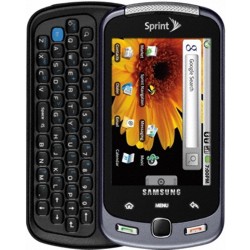
The Samsung Moment is another Android phone that has been designed by Samsung but this time for Sprint. The Samsung Moment is a black slider with a QWERTY keypad that slides out from the side. The primary screen is a full touch 3.2 inch AMOLED. However, do not worry as you are provided with some basic physical controls as well for those of you wary of a full touch phone. The design although pretty stylish and corporate feels a little bulky. Also, there is a hint of a plastic like feel to it which is not a great thing for such a hi-tech phone like the Samsung Moment. All the information that we have about this Android phone was spilled out accidentally by Samsung in a press conference about a completely different product. We do know that the release date for the Samsung Moment has been finalized and is the 1st of November.
Apart from the AMOLED screen which makes images look brighter and sharper there are many other features that will definitely not disappoint you. The screen itself is so designed that it makes pictures appear clear and vibrant irrespective of the angle of viewing. The phone also comes with an optical joystick and 3G connectivity which is a boon to mobile internet users. 3G is the most trusted amongst all others and provides great surfing and downloading speed. The other great thing about this Android phone is that all the Google applications are easily accessible from the Samsung Moment. These include Google Maps, YouTube, Google Search and Gmail. So this means that the Samsung Moment is the perfect phone for those who like to stay connected even while on the go. In addition to this, the phone also packs in all the games, applications and widgets that are provided by the Android systems.
Wi Fi and GPS are also included in this multi faceted phone. The GPS system is the best with access to all corners of the world. You can keep track of where you friends are and know about their exact locations at particular times of the day. You can also use the directions provided to reach their location in no time at all. The directions are accurate and simple and do not confuse you at all even if you are new to the place. There is a 3.2 mega pixel camera that takes brilliant pictures as well as a camcorder, which records without the slightest of hitches. Apart from that there is also an accelerometer and stereo Bluetooth. With the Samsung Moment you can also directly access the social networking sites like Twitter, Flickr and Facebook.
The Samsung Moment also includes a 2GB micro SD slot and the memory can be expanded to up to 32 GB. The phone also has gotten rid the old proprietary jack and adopted the new 3.5 mm jack that is more convenient to use. The battery backup is great giving a maximum of 5.5 hours of talk time. So basically the Samsung Moment is a near perfect phone with slight minor flaws that can easily be overlooked.

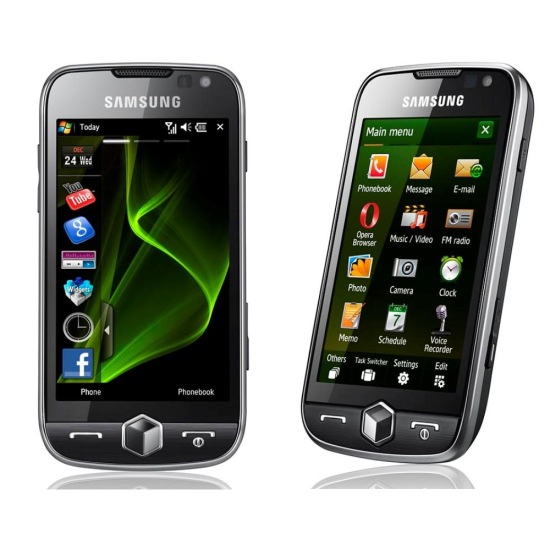
Number 09: Samsung Omnia II


The Omnia II features a 800 x 480 pixel AMOLED touchscreen display that sports the new TouchWiz 2.0 user interface. TouchWiz 2.0 on Windows Mobile replaces a lot of the stock Windows Mobile 6.1 user interface aspects with slicker looking Samsung developed controls. TouchWiz 2.0 features multiple desktops for widgets, and replaces both the Start menu and Settings menus. All in all, its a very good looking UI.
While the Omnia II will initially ship with Windows Mobile 6.1 Professional Edition, Samsung has assured us that it will be upgradeable to Windows Mobile 6.5 when that becomes available.

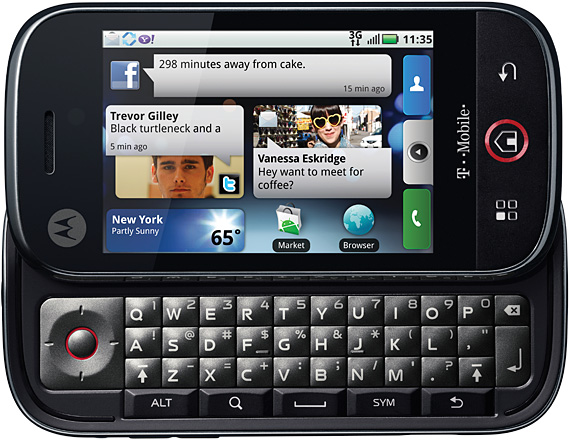
Number 08: Motorola Cliq


The Cliq was announced a few weeks before CTIA, and we saw a lot of this intriguing handset at the show. While I used the Cliq only briefly, I already knew that I liked its design best out of all the Android phones. Like the Samsung Moment, it has a keyboard and a touchscreen. A physical keyboard is necessary, as the native touch keyboard on the current version of Android is far from perfect (as we found out in our review of the T-Mobile myTouch and the HTC Hero). I got some more hands-on time with the Cliq at CTIA and loved the keyboard’s ergonomics and bubble-like keys.
The Motorola Cliq will also be the first phone to showcase MOTOBLUR, Motorola’s skin for Android. In my quick hands-on tests, I found the MOTOBLUR interface to be clean, intuitive, and responsive. MOTOBLUR has a lot of cool features, such as a Happenings widget that gives you instant access to your social networks from the home screen. It also aggregates all your contacts and their information from various sources and displays them in one seamless client.

Number 07: HTC Droid Eris
Beginning Nov. 6, DROID ERIS™ by HTC will invade Verizon Wireless Communications Stores across the United States, bringing the power of the Android™ platform and the Verizon Wireless network together. DROID ERIS by HTC combines the popular Android platform with HTC Sense™, a user experience from HTC that makes it easy for customers to stay close to one another and create an individualized mobile experience tailored specifically to their needs.
DROID ERIS by HTC offers customers the opportunity to customize a seven-panel wide home screen with a wide variety of widgets designed to bring the most important information to the surface. DROID ERIS by HTC also includes the innovative “Scenes” feature, which allows customers to create multiple home screens, each with different widgets and shortcuts, to transform DROID ERIS by HTC from a “work” phone to a “play” phone with just a touch of a finger.
DROID ERIS by HTC also organizes interactions by person, which makes it possible to access text messages, e-mails, phone calls and even Flickr streams and Facebook updates from a single contact card. The unique HTC Sense experience found on DROID ERIS by HTC is supported by an array of the latest mobile features, including:
- 3.2 inch capacitive touch screen and trackball interface
- 5.0 megapixel auto focus camera
- Expandable memory with pre-installed 8 GB microSD™ card (up to 16 GB supported)
- Supports USB mass storage
- Bluetooth®, Wi-Fi and 3.5 mm headset connectivity
- Integrated GPS and a digital compass with a sensor that enables the phone to know what direction it is facing
- Smart dialer for simplified dialing by name, number or initials
- Full HTML browser with Flash Lite capabilities
- Seamless compatibility with Google™ services like Google Maps™, Gmail™, Google Search™ and more


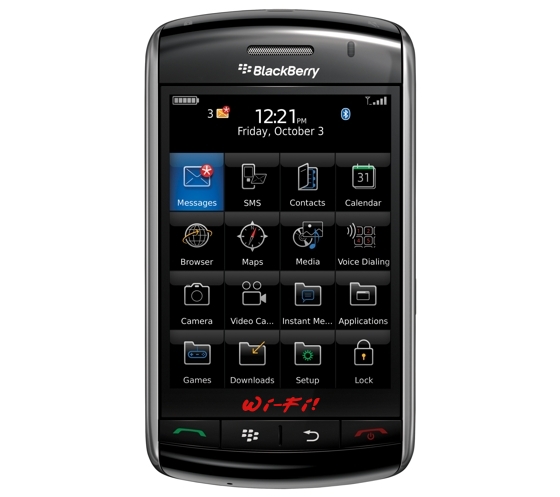
Number 06: BlackBerry Storm 2


The Blackberry Storm 2 is a vast improvement on its predecessor, the Blackberry Storm. There are many minor changes that have been made in this phone which add up to produce cumulative result that is much better than the Blackberry Storm. This goes to show that little changes can make a major difference. The Blackberry Storm 2 is what a carefully designed Blackberry Storm should have been. Nonetheless, with the Blackberry Storm 2 coming in the market pretty soon most of you will forget the flaws that the Blackberry Storm had. The Blackberry Storm 2 has a revamped exterior that makes the phone look a lot less bulky and gives it a smooth and uninterrupted feel. The glossy black exterior makes it suitable for corporate as well as personal use. The Blackberry Storm 2 is rumored to also have been named as the Odin and the model number is now confirmed to be 9550.
The minor changes that have been made in the Blackberry Storm 2 that make a major difference are quite a few. However the phone’s size still remains the same at dimensions of 112 x 62 x 14mm. One major change that we can visually detect in the Blackberry Storm 2 is the screen. The normal screen has been replaced with a touch screen and the physical buttons have also been done away with and in their place you have the smart, easy to use virtual buttons. The buttons on the side that were too elevated and were a constant source of irritation in the Blackberry Storm has now been replaced by smoother buttons that are more comfortable to feel. Another great detail that has been looked into and dealt with very well is the joints. They are now as smooth as never before and are absolutely glorious to touch. The best part is you can’t even feel that they are there! This also enhances the grip on the phone and makes it a pleasure to hold rather than an added responsibility.
The buttons on the touch screen have been replaced to bring in more user-friendly realistic buttons that display whatever you choose on the phone’s screen. Although you still have to press the button twice to actually activate the program, this is a feature that was intentionally retained. This is a feature of the SurePress technology which although did not receive very good reviews with the last Blackberry is still incorporated in this one. This is because according to the manufacturers this technique has more pros to its name than cons. The size and the resolution of the screen, however, still remain the same as in the Blackberry Storm. The size is 3.25 inches with a resolution of 480 by 320 pixels. The screen is also rumored to not depress when the phone is either locked or is switched off.
Overall, the Blackberry Storm 2 is a major improvement on the Blackberry Storm due to the minor changes that have been incorporated in to it by the manufacturers. The phone is said to release in around the second week of November, tentatively o the 11th.


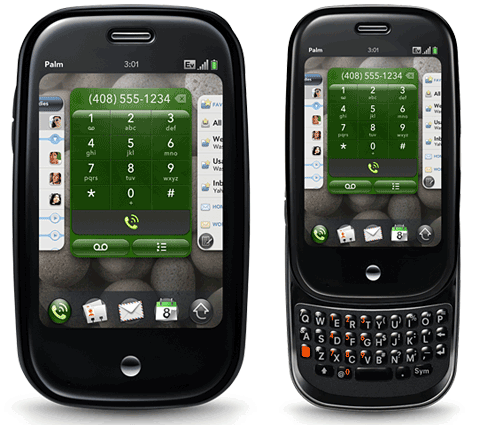
Number 05: Palm Pre


With the entire buzz and the hype around for the latest smart phone addition, Palm Pre has been into limelight for being considered as one of the best smart phones available at present. The unique design, the awesome features and connectivity makes this set a must have for all mobile lovers. Palm Pre has already been creating a lot of gossips and has been receiving great reviews ever since its launch. Let us look into the details of this mobile and check for the uniqueness of this smart phone.
Peaking of the design, the mobile comes in a vertical slider based mobile offering a full QWERTY keyboard. The mobile is well known for its portability. It weighs around 135 grams. The size of this mobile is small and does not look bulky at all, like other smart phones do seem to be so. The size can be compared to an iPhone touch and in fact, it is of lesser size than iPhone when closed! Being small in size, it still offers a great display and the 3.1 wide inch touch screen displays the colors brilliantly. It gives a resolution of 320×480 pixels which is quite great. The high glossiness of the screen may cause some issues while using it in sunlight but still it does not reflect too much.
Among the features, this mobile comes in with an accelerometer which works great with web browsing and image viewing. Besides the regular features like Bluetooth 2.0, EDGE, Wi-Fi and others, it is best known for the unique new platform Palm web OS which makes it connected to the Web continuously non-stop. The browsing is high speed and so are the others features of this mobile. The talk time and the battery life of this mobile is also modest, if not great. The memory can be expanded to about 8GB as well. Besides, the OS also has a unique search program which will start searching the words you type in.
Speaking of its camera, if offers great picture and movie quality. Thanks to the 3 mega pixel camera embedded in it. It also has an LED flash in it and range of other options for its camera. The music quality is great and offers good audio and video with proper resolution as well. Some of the features which are missing include absence of MMS messaging and the unavailability to copy and paste option. Having said this, to sum up this mobile is into a lot of buzz and surely, it has lived up to its expectations. It is priced well and is competitive in the market of smart phones as well. The mobile is made unique and can be claimed as one of the best smart phones around. With an excellent new concept OS and regular connectivity to the Web makes this mobile competitive.

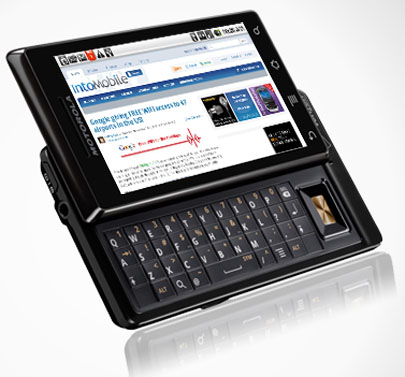
Number 04: Motorola Droid


Motorola Droid enabled you to high-speed web browsing, voice-activated search, customizable large screen, access to thousands of Android applications and hundreds of widgets and the best 3G mobile network in the country.
Verizon Wireless, the company with the nation’s largest wireless 3G broadband network, and Motorola, Inc. (NYSE: MOT), a pioneer in the mobile industry, unveiled DROID by Motorola, the first smartphone powered by Android™ 2.0. DROID by Motorola features the brainpower and breakneck speed of a modern smartphone, designed to outperform where other smartphones fall short.
“We’re proud to work with Verizon Wireless and Google™ on the first smartphone to feature Android 2.0,” said Sanjay Jha, co-chief executive officer of Motorola and chief executive officer of Motorola Mobile Devices. “DROID by Motorola delivers a rich consumer experience with warp-speed Web browsing, a mammoth screen, and Motorola’s expertise in design and voice quality. Combined with Android’s open, flexible graphical user interface and the power of Verizon Wireless’ 3G network, DROID is a smartphone that simply doesn’t compromise.”
“This is an exciting announcement for Verizon Wireless, as the DROID by Motorola is the first device that we are bringing to market under our ground-breaking strategic partnership with Google,” said John Stratton, executive vice president and chief marketing officer for Verizon Wireless. “DROID by Motorola gives customers a lifestyle device with access to more than 12,000 applications that will help them stay in touch, up to date and entertained, using the best 3G network in the country.”
DROID by Motorola has a solid exterior, intelligent interior and is one of the thinnest full-QWERTY slider phones available. It is a no-fuss, high-tech, location-aware, voice-recognizing, over-the-air updating, multi-tasking machine – and it is available just in time for holiday wish lists.

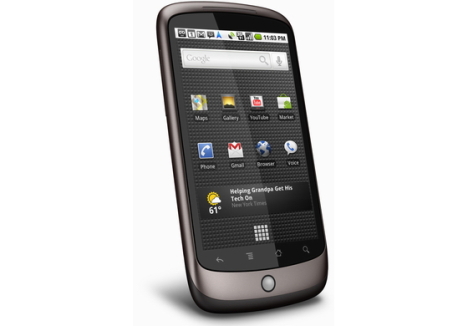
Number 03: Google Nexus One


THE GOOD:

The Nexus One has a gorgeous display, a lightning-fast processor, and a loaded feature set. The enhanced voice capabilities worked flawlessly, and the phone delivers solid performance.

THE BAD:

Like other Android phones, the Nexus One forces you to store apps on the internal memory. The media player remains average, and it’s missing some wanted features like hands-free Bluetooth dialing. Currently, Outlook Calendar syncing is not available.

THE BOTTOM LINE:

It doesn’t have all the features we’d like, but the Nexus One greatly enhances the Google Android family with a fast processor, good call quality, and improved voice control features. What’s more, we love that all versions of the phone will be unlocked.

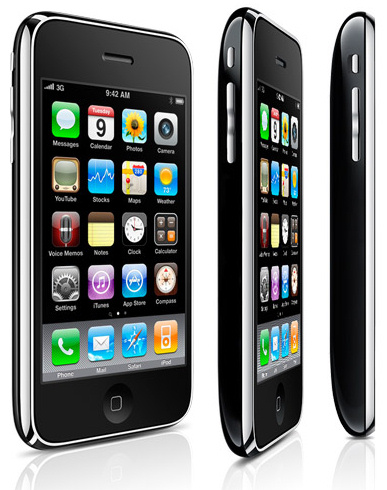
Number 02: Apple iPhone 3GS


THE GOOD:

The iPhone 3GS finally adds common cell phone features like multimedia messaging, video recording, and voice dialing. It runs faster; its promised battery life is longer; and the multimedia quality continues to shine.

THE BAD:

The iPhone 3GS’ call quality shows no improvements and the 3G signal reception remains uneven. We still don’t get Flash Lite, USB transfer and storage, or multitasking.

THE BOTTOM LINE:

The iPhone 3GS doesn’t make the same grand leap that the iPhone 3G made from the first-generation model, but the latest Apple handset is still a compelling upgrade for some users. The iPhone 3GS is faster and we appreciate the new features and extended battery life, but call quality and 3G reception still need improvement.


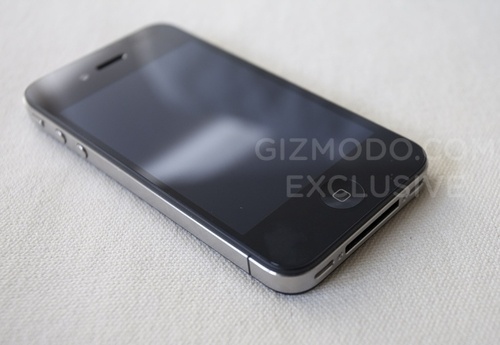
Number 01: Apple iPhone 4G


Lots of speculation is going around on the new iPhone 4g… in HD!! Official features will be revealed at the WWDC conference this June. Here is a video leaked by GIZMODO

Tuesday, August 7, 2012

7 Weird Weapons Of World War II

Between 1939 and 1945, one of the worst wars in history was fought out between two opposing forces that were so large and wide-spread, it became known as the Second World War. In a bid to stop Adolf Hitler and his allies, who were known as the ‘Axis’ powers, the ‘Allies’ worked on many weapons projects to try to develop new ways to help them win the war. While many were successful and eventually helped the allied cause, other ideas that went into development ended up being shelved, often because they were just a little too weird to work!
7. The Pigeon-Guided Missile


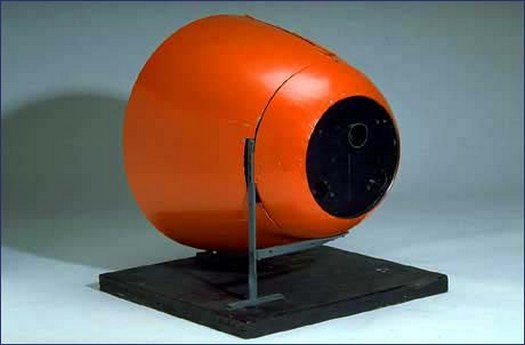
American behaviorist B.F. Skinner hit on a novel idea for the war effort when he came up with the idea for ‘Project Orcon’ (which stood for organic control), which was his attempt to produce the world’s first pigeon-guided missile.
The control system had a lens attached to the missile which projected an image of the target to a screen. Three trained pigeons would then peck at the target on the screen and where they pecked would determine where the missile hit. As long as they pecked the center of the screen the missile would remain on target but if they pecked off center, the missile would change course, as long as two of the three had it right though, the target would be hit
The National Defense Research Committee put $25,000 for research into the project but despite this, for some unfathomable reason, the US military didn’t take the idea too seriously. On the 8th October, 1944 the project was canceled, the official reason given was; ”further prosecution of this project would seriously delay others which in the minds of the Division have more immediate promise of combat application.”


6. The Flying Jeep


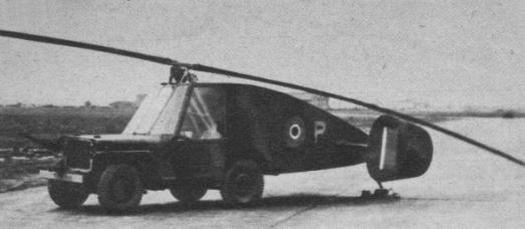
The Airborne Forces Experimental Establishment in Manchester, UK began work in 1940 on attaching rotor blades to a jeep. Nicknamed the ‘Rotabuggy’, initial tests involved dropping the jeep from heights of a few meters while it was filled with concrete to demonstrate it could take the impact without damage.
The jeep was then fitted with additional equipment including the rotor blades, a tail fairing with twin rudderless fins, a rotor control next to the steering wheel and glider navigational instruments. In 1943, the first test flight was conducted when the Rotabuggy was toed behind a Bentley and managed to glide at speeds of up to 65 mph.
The initial flights had limited success as handling proved difficult but after some modifications, the flying qualities of the vehicle were officially described as “highly satisfactory”. However the project became deemed unnecessary with the development of Horsa II and Hamilcar which were gliders equipped to carry vehicles.

5. The Poisoned Dart Bomb


Between 1941 and 1944, British scientists were working on a top secret project to developed a projectile bomb that released darts tipped with poison. A recently de-classified document entitled ‘Research Into Use of Anthrax and Other Poisons for Biological Warfare’ revealed that sewing machine needles would be used in the weapon and tipped with a lethal poison, which would probably be either anthrax or ricin.
According to a 1945 memo about the project, light darts could be used as the poison ensured slight penetration would be lethal and there was no need to hit vital organs. It also had the added advantage, according to the memo, of making it so that medical treatment would be unlikely to prevent the victim’s death.
The bombs could carry 30,600 needles and if they hit, you were likely to be dead within half an hour. However the chances of hitting someone varied and while they would have had great effect against troops out in the open, they were virtually useless when there was any type of cover. This made them unlikely to cause mass damage frequently and therefore uneconomical and as a result, they never made it passed the planning stage.

4. Anti-Tank Dogs


Anti-tank dogs or dog-bombs were dogs that were trained by the Soviet military to seek food under tanks and armored vehicles. The dogs were left hungry for a few days and explosives strapped to their backs, they would then be left to wander fields where enemy tracked vehicles approached. As they went under the vehicle, the explosives were detonated by a wooden lever that would be triggered as they went under.
Soviet reports claim that the dogs managed to disable 300 German tanks and caused enough of a problem to the Nazis that they took measures against them. Dogs were ordered to be shot on sight and flame throwers deployed on tanks and armored vehicles to ward them off in the field.
In an unfortunate incident in 1942, the use of the dogs went horribly wrong as a group of the hungry hounds ran amok. This forced an entire division of Soviets to retreat from the battlefield and soon after the anti-tank dogs were withdrawn from regular service, however they continued to be trained right up until 1996.

3. Ice Ships


In 1942, the allies were suffering heavy losses of merchant ships to German U-boats as a result of the limited range of patrolling aircraft. Lord Louis Mountbatten suggested building large ships made of ice to protect allied merchant ships and possibly as a platform to launch an offensive from. Mountbatten, the Chief of Combined Operations, an organization responsible to the Chiefs of Staff for the development of equipment and special craft for offensive operations, had been advised by one of his scientists, Geoffrey Pyke, that huge ships of up to 4,000 feet long and 600 feet wide could be made cheaply and in large numbers.
Winston Churchill, Britain’s PM was enthusiastic of the project and saw to it that it got underway. In 1943, it was discovered that by adding wood pulp to the water before freezing, a very tough material was made which was called ‘pykrete’, in honor of Geoffrey Pyke. It was reported that when demonstrating the idea to a group of high brass military leaders, Mountbatten fired a shot at an ordinary block of ice, which shattered into little pieces. However when he fired at the Pykrete, the bullet bounced right off and almost hit the Chief of Air Staff Sir Charles Portal.
Construction on a prototype began at Patricia Lake in the Canadian Rocky Mountains, and it was determined that the hull needed to be at least 35 feet thick in order to contain damage from bombs and torpedoes. However before tests were complete, the Battle of the Atlantic had been virtually won and with the construction underway of the new aircraft carriers, the project was reluctantly abandoned in August 1943.

2. Fire Balloons


A fire balloon, balloon bomb, or Fu-Go was an experimental weapon launched by Japan during World War II. A hydrogen balloon with a load varying from a 12-kilogram (26 lb) incendiary to one 15 kg (33 lb) antipersonnel bomb and four 5 kg (11 lb) incendiary devices attached, they were designed as a cheap weapon intended to make use of the jet stream over the Pacific Ocean and wreak havoc on Canadian and American cities, forests, and farmland.
The balloons were relatively ineffective as weapons and were used in one of the few attacks on North America during World War II.
Between November 1944 and April 1945, Japan launched over 9000 fire balloons. About 300 balloon bombs were found or observed in North America, killing six people and causing a small amount of damage.


1. Bat Bomb


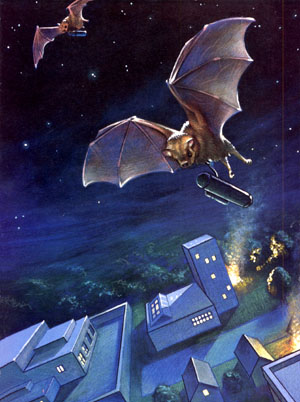
Bat bombs were bomb-shaped casings with numerous compartments, each containing a Mexican Free-tailed Bat with a small timed incendiary bomb attached. Dropped from a bomber at dawn, the casings would deploy a parachute in mid-flight and open to release the bats which would then roost in eaves and attics. The incendiaries would start fires in inaccessible places in the largely wood and paper construction of the Japanese cities that were the weapon’s intended target.
Developed by the United States during World War II, four biological factors gave promise to this plan. First, bats occur in large numbers (four caves in Texas are each occupied by several million bats). Second, bats can carry more than their own weight in flight (females carry their young — sometimes twins). Third, bats hibernate, and while dormant they do not require food or maintenance. Fourth, bats fly in darkness, then find secluded places (often in buildings) to hide during daylight.
The plan was to release bat bombs over Japanese cities having widely-dispersed industrial targets. The bats would spread far from the point of release due to the relatively high altitude of their release, then at dawn they would hide in buildings across the city. Shortly thereafter built-in timers would ignite the bombs, causing widespread fires and chaos.Here is a documentry made by History Channel on Bat Bombs